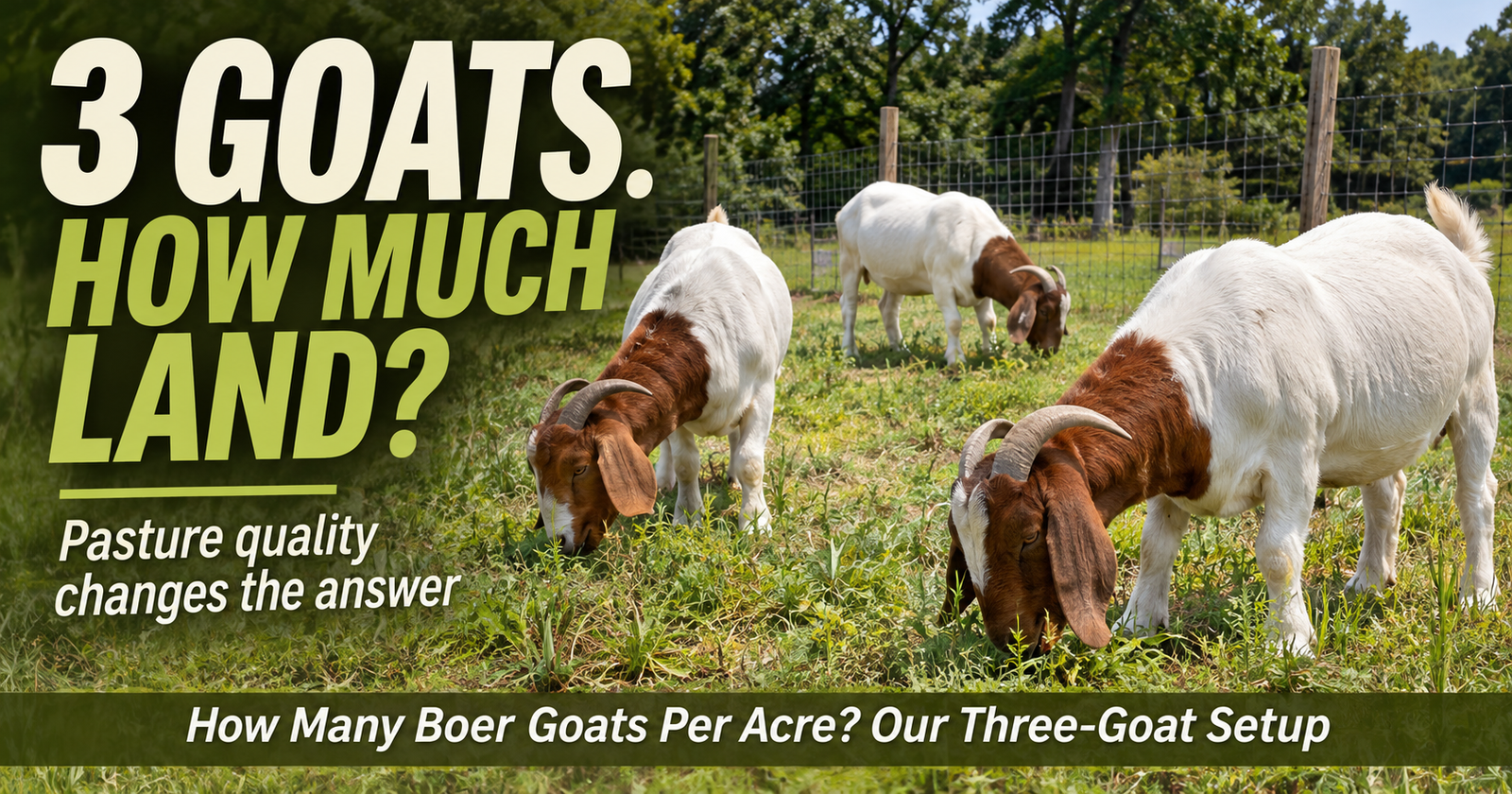
We keep three Boer goats on about 1.5 to 2 acres here in rural Missouri, mainly for brush control. That puts our setup at roughly 1.5 to 2 Boer goats per acre. It’s a real example you can compare with your own property, but it isn’t a promise that the same acreage will feed your goats year-round.
Our goat area includes blackberry bushes, thorny briars, vines, tall weeds, and small trees. We’re keeping goats to help manage that growth, so the kind of land matters just as much as the amount.
If you’re looking at a couple of acres and wondering whether Boer goats make sense, here’s where I’d start.
How many Boer goats per acre is reasonable?
There’s no single goats-per-acre number that works for every property. You need to consider what grows there, how much the goats can actually eat, and how you’ll feed them when that growth runs short.
Before you pick a number, separate these three questions:
- How much room do I have for goats?
- How much feed can that land produce?
- How many goats can I reasonably care for through the whole year?
Those answers won’t necessarily match.
You might have enough physical space for several goats while needing to supply much of their forage as hay. Or you might have plenty of seasonal growth but a muddy, difficult setup once winter arrives.
University of Nebraska Extension recommends using local stocking guidance because vegetation and growing conditions affect what land can support. Animal size matters, too. Counting goats without considering their weight leaves out part of the feeding calculation.
What our three-goat setup actually tells you
Here are the confirmed details behind our example:
- Herd: Three Boer goats.
- Location: Rural Mid-Missouri.
- Area: Approximately 1.5 to 2 acres.
- Purpose: Brush control and property maintenance.
- Vegetation: Mixed briars, blackberry bushes, weeds, vines, and small trees.
That’s the useful starting point. We aren’t describing a dairy herd or a commercial meat-goat stocking system.
The acreage math
At the smaller end of our acreage estimate, three goats divided by 1.5 acres equals two goats per acre.
At the larger end, three divided by two equals 1.5 goats per acre.
That describes how many goats occupy our space. It doesn’t establish how much feed the property supplies or the maximum number it could support.
Why your two acres might be different
Picture two properties.
One has a closely mowed field with a few shade trees. The other has reachable leafy brush, brambles, and mixed pasture.
They’re the same size on paper. They offer goats very different feeding opportunities.
Our example is most relevant to someone considering a small herd for a property with mixed brush. It’s less useful as a comparison for a bare lot or a neatly maintained lawn.
Count reachable food, not everything green
A tall tree can make a property look lush while offering very little a goat can reach.
A thick brush patch can be misleading, too. There’s a difference between leafy growth and a tangle of old woody stems.
Goats generally prefer shrubs, saplings, and brambles when they have a choice, according to University of Nebraska Extension. That browsing preference helps explain why they’re useful on overgrown properties.
Walk the property before choosing the herd
Look for three things:
- Reachable growth: What suitable leaves and forage are within reach?
- Plant identity: Do you know what the shrubs, weeds, and vines are?
- Usable ground: How much of the enclosure is productive, rather than bare, paved, or occupied by buildings?
Unknown plants shouldn’t count toward your feed supply until they’re identified.
And land outside the goats’ enclosure doesn’t belong in the calculation. Owning three acres isn’t the same as giving the goats access to three acres.
Brush control creates a problem you should plan for
Our goats are here to help manage vegetation. But think about what happens when goats reduce the growth you wanted them to work on.
There may be less available to eat afterward.
That’s easy to overlook when you’re standing in front of an overgrown patch and thinking about how badly you want it cleaned up.
Cleanup numbers and permanent herd numbers are different
A temporary brush-clearing herd can move to another job. Your own goats still need somewhere to live and something to eat after the initial growth is reduced.
Before buying goats for an overgrown property, work through the next stage:
- Will they move to another section?
- Will the browsed area have time to recover?
- Will you provide hay when suitable growth falls short?
- Do you want to keep that many goats after the cleanup?
MU Extension identifies goats as useful brush-control animals, while emphasizing that stocking decisions depend on pasture quality, rainfall, soil fertility, and season.
Plan for the months when the land produces less
Here in Missouri, we have to think beyond a leafy growing-season property.
Dormant plants won’t keep producing fresh growth through winter. Dry weather can reduce the available forage during warmer months, too.
For a new owner, that makes the feed plan part of the acreage decision from the beginning.
Have an answer to these questions
- Where will you buy suitable hay?
- Where will you store it out of the weather?
- Can you reach the feeding area when the ground is muddy?
- Can your budget handle purchased feed when the property falls short?
Don’t assume that buying goats for brush control means the land will cover their entire diet.
Their needs also change with age and production stage. A growing goat or nursing doe may require a different feeding plan from a mature goat being maintained at a healthy weight.
Can you keep Boer goats on one acre?
Possibly, with an appropriate feeding and management plan. One acre alone doesn’t tell you whether a particular herd will work there.
You still need suitable fencing, shelter, water, and a way to manage the ground when it gets wet or heavily used.
Our three goats occupy approximately 1.5 to 2 acres. I wouldn’t turn that into a recommendation to put three Boer goats on every one-acre property.
Room to live and land to feed them are different
A smaller enclosure with purchased forage is a different system from a property expected to provide most of the goats’ food.
Both require planning. The smaller setup doesn’t become self-sufficient just because the goats physically fit inside the fence.
Will dividing the pasture let you keep more goats?
Dividing land can help you manage access and give sections time to rest. It doesn’t automatically increase the amount of feed available.
Split two acres into two equal sections, and the goats have one acre available while the other rests.
That resting acre has a job to do. It needs time and suitable conditions to regrow before it’s useful again.
MU Extension describes rotational grazing as a tool for managing grazing height and reducing parasite exposure. The benefit depends on how the system is managed.
A second gate is useful. It isn’t a reason by itself to buy more goats.
Signs you need to rethink your goat count
Choosing the herd size is the beginning. You still need to watch what happens to the land and the animals.
Reasons to reassess include:
- Bare areas keep expanding beyond the usual paths and gathering spots.
- Fresh regrowth gets eaten repeatedly before plants recover.
- Suitable forage becomes scarce even though plenty of woody stems remain.
- Goats struggle to maintain condition, which needs individual attention.
- Feed costs or chores exceed what you can manage consistently.
Poor condition isn’t proof that you simply have too many goats. Nutrition, parasites, illness, and other problems can overlap. A goat losing condition needs more than an acreage calculation.
Before you bring home your first Boer goats
For someone starting with a property similar to ours, I’d put the work in this order:
- Measure the area the goats will actually use.
- Identify the vegetation growing inside it.
- Plan fencing, shelter, water, and feeding access.
- Price the hay you may need during seasonal shortages.
- Discuss your proposed herd with your local Extension office.
Tell the Extension specialist whether you want ongoing brush management, a temporary cleanup, or a herd supported mostly by pasture. Bring photos of the land if you can.
“Three goats on two acres” gives them a number. Photos, plant information, and a feed plan give them something they can help you evaluate.
About the author
The Goat Know How Farm Team shares the owner’s firsthand experience keeping three Boer goats on approximately 1.5 to 2 acres in rural Missouri for brush control and property maintenance. Articles combine that farm background with clearly identified Extension research. Visit Goat Know How for practical information about small-herd goat ownership.